First, I would like to tell you how I made these sounds: https://petke.info/syntsat1.mp3 for the piece.
They were created by me, REBOL and the ffmpeg program in collaboration. And of course, everyone who has uploaded free synth sounds to pixabay:
https://pixabay.com/fi/music/search/synthetisaattori/?duration=0-30
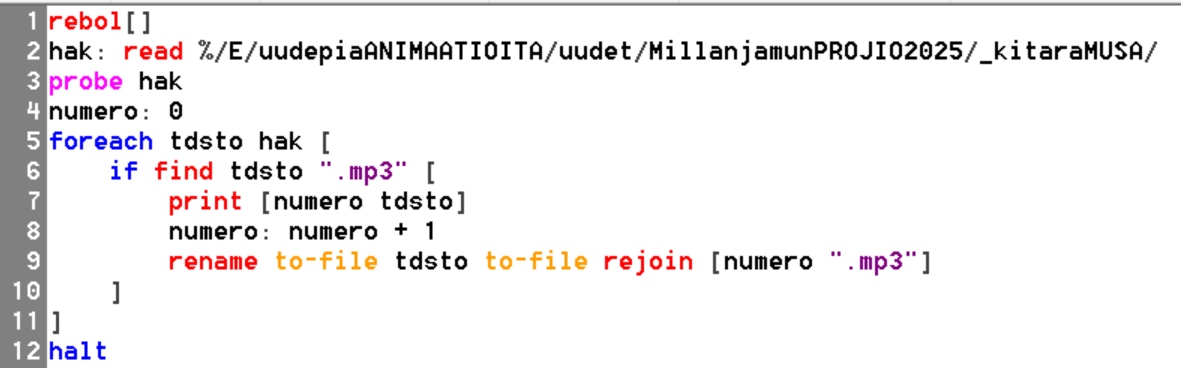
When all the 51 different short synth sounds that I downloaded were in one folder, I first had to name them 1.mp3, 2.mp3, ..., 51.mp3, which I did with this program:
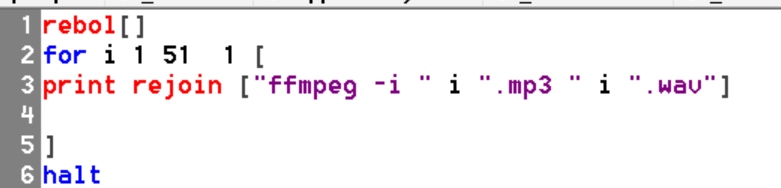
Then I had to change them to .wav types, because I have noticed that when you combine .mp3 types, you sometimes get terrible interference and distortion. This program:
prints the commands that I copy/paste into the command.cmd script - of course I could have printed the commands directly into the .cmd file, but I didn't have the energy.
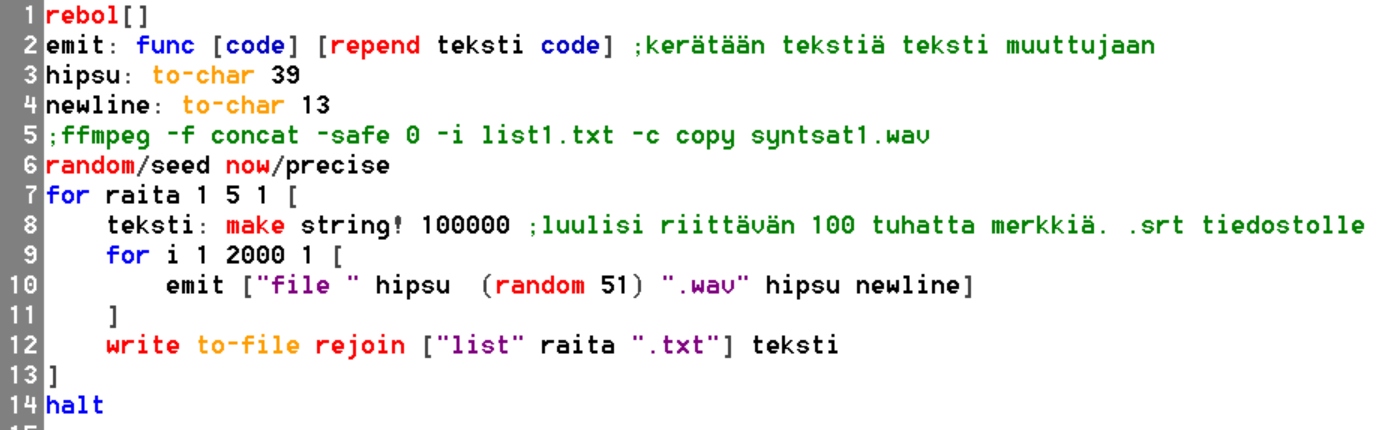
Then I messed up the order of the 2000 sound clips out of 51 and produce a list with 5 tracks:
https://petke.info/playsounds.jpg
After running that program, I have five lists with the sounds sorted in random order. After that I run the commands from the command line:
ffmpeg -f concat -safe 0 -i list1.txt -c copy synthsat1.wav
ffmpeg -f concat -safe 0 -i list2.txt -c copy synthsat2.wav
.
.
.
ffmpeg -f concat -safe 0 -i list5.txt -c copy synthsat5.wav
(of course, this could have been automated too, but not everything needs to be)
That's it! Now I had five tracks, which were probably about two hours long, but I uploaded three of them to the audio editor Audacity and shortened them to an hour.
The code I was running was as long as a famine year. It called 31 subroutines from its main program. Here is the program.https://petke.info/code.html
I have a program that can produce an infinite number of different images, 300 of which can be seen there:
https://petke.info/uus/points.html
I collaborate with the painter Milla Isomäki. I made a unique animation for each of her paintings, of which I have 34.
So now I have a program that produces "practically infinitely" different images and a program that produces 34 different animations from the images. I make an image and assign it an animation - or not quite so much. I made a program
I make the sounds for my own work in the same way, but I think I'll draw 4000 sounds of the sytsa one after the other on one track - if that's not enough for an hour-long video, I can increase the number or cut and paste a little in the Audacity music editor. Unfortunately, I only found 51 sytsa sounds on Pixabay that I think are suitable. The soundscape of the work would have been even richer and more varied if I had more of them.
But on the other hand, it's good that the music has repetition. You can listen to the sounds of the work there:
https://petke.info/syntsat1.mp3
Millan and I've got this structure in our video:
1) show 20 seconds of animation of the picture of the board so that the video effect of the VSDC video editor happens in time with the sounds, but in such a way that the four different effects change every five seconds.
2) Show a still image with its name for 5 seconds (I have my own program that produces subtitles from the images in the board in exactly the right place with a so-called .srt file).
I had to cut the videos made with four different effects into five-second pieces. And put the puzzle together. I did this with the DRPU Video Splitter and Cutter program. I used many self-made REBOL programs to help me.
I made five types of movies.
1) with glass effect
2) with flow effect
3) with push effect
4) with bokeh effect
5) without effect
For all effects, I use the Edit the Beat function of the VSDC editor, so the effects happen in time with the sounds. Then I cut all the movies into 5-second segments in different subfolders. The essential part of the program is this:
list: read %./
sort list
;leave: 1 ;glass - remove others
;leave: 2;flow
;leave: 3 ;push
leave: 4 ;bokeh
;leave: 5 ;clear
i: 1
until [
if not find list/(i) ".r" [
either i = leave [
print ["leave" i]
leave: leave + 5
][
print ["delete " i]
delete to-file rejoin [i ".mp4"]
]
]
i: i + 1
i > length? list
]
halt
Each movie is therefore cut into 720 parts (720 * 5 s = 1 hour). And that code above. removed all unnecessary video clips from the bokeh effect folder.
Then I just move the video clips from each folder into one folder and from there into the VSDC editor.
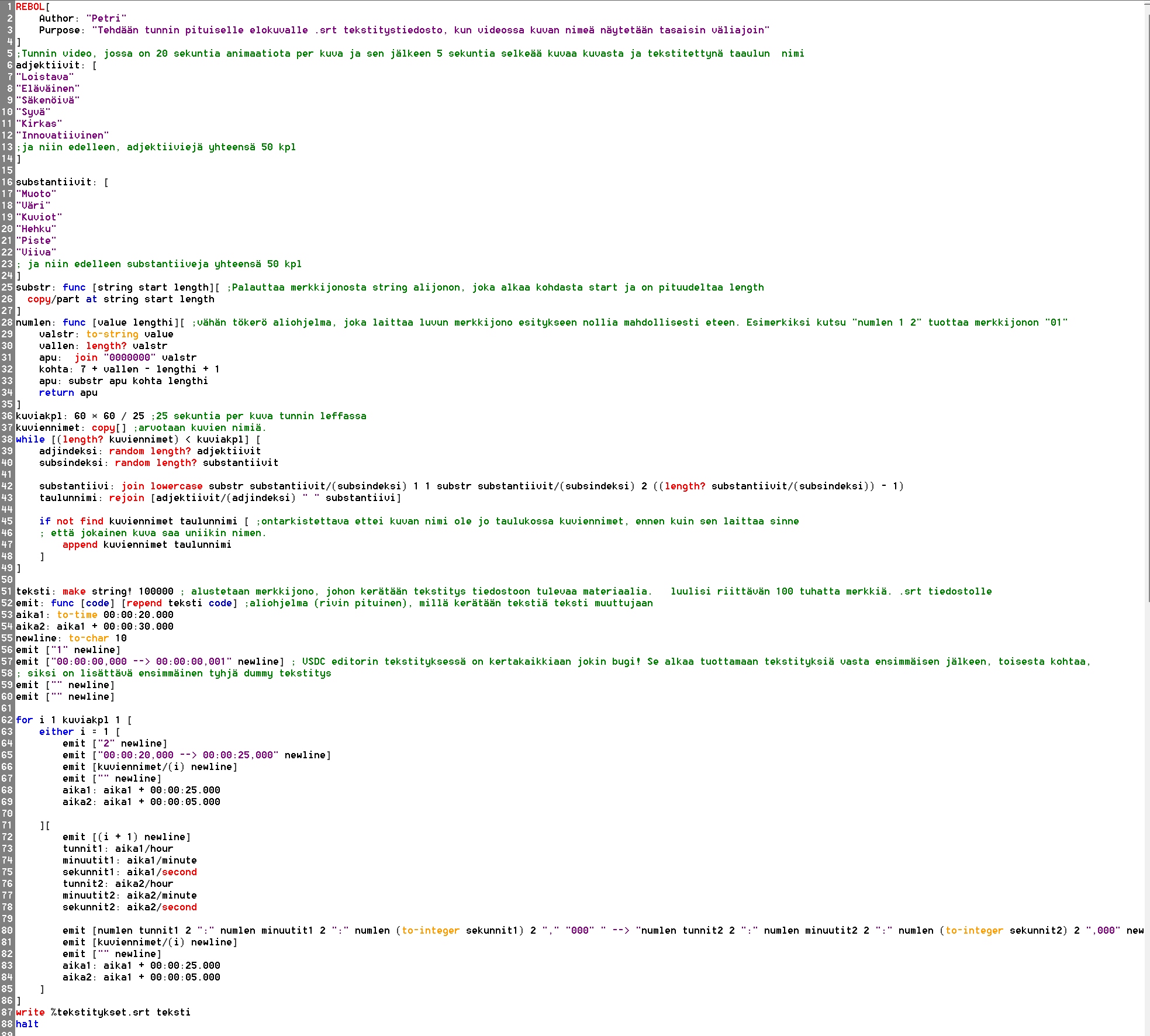
I made the subtitles with this program: https://petke.info/KoodiJollaVideoTekstitetaan.jpg
The same structure will be maintained in my video. The name of the image, made by ChatGPT, is also unique. For example, the subtitle file looks like this:
73
00:29:55,000 --> 00:30:00,000
Echoes of Color
74
00:30:20,000 --> 00:30:25,000
Pulsating Logic
75
00:30:45,000 --> 00:30:50,000
Luminous Rhythm
76
00:31:10,000 --> 00:31:15,000
Data Storm
That's about "technology". Let's go for a moment to a much more foreign topic to me, namely the philosophy of art or something like that - explaining the meanings of works of art.
My work is a great fusion of computing, technology and art. Where the three things come together, something new and unique is sometimes created. My work itself is already poetry of art technique, but there is also real poetic art in it: each unique image in the work gets a unique name.